in the age group of 18-29 years are unemployed, according to a government survey.
youth enter the Indian job market every year.
Of the 430 million youth in India, 86% drop out of school after 15 and only 2% can access formal training. According to a government survey, 13 in 100 in the 18-29 age group are unemployed. With 10 million youth entering the job market every year, the country faces a huge challenge of creating employment for them. The challenge is bigger in rural areas, where nearly 70% of the population live and depend primarily on small holder agriculture. It is of utmost importance, on one side, to fill in the skill gaps of the unorganised sector in India – on the other hand, to create value chain and appropriate market system for small holder products.
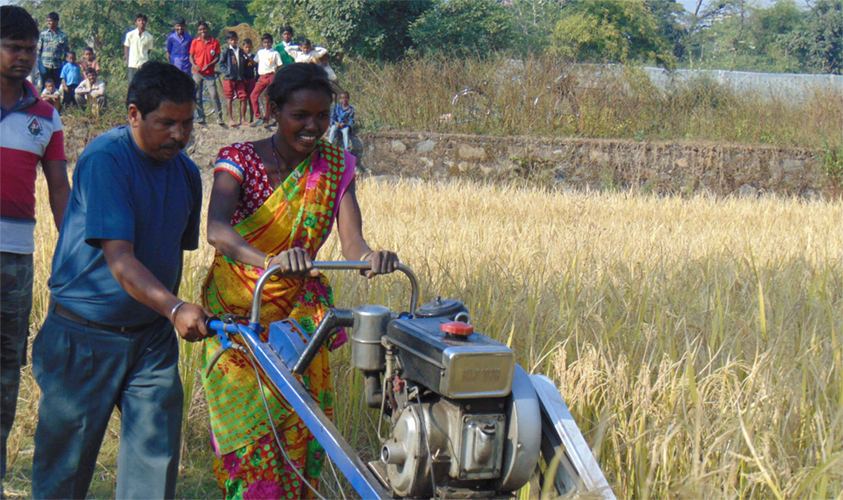
The Green College initiative has been developed for skill development on green trades such as sustainable farming, animal husbandry, veterinary paraprofessionals, integrated fishery, sustainable harvesting and processing of forest produce and solar lighting. The training courses combine the traditional wisdom of these communities with modern scientific knowledge to help the small producers grow into `ecopreneurs’ by having better access to business development skills, entrepreneurial skills and technology, thus ensuring higher income and bringing back pride and dignity to these rural professions. The skill development programme for rural youth was successful in raising their income level by creating better access to technology, finances and market. Currently, Welthungerhilfe supports 13 Green Colleges and Skill Green Global – an institute which supports Green Colleges and similar initiative.
Developing ecopreneurs is supported by a complementary initiative ‘Bhoomi Ka’ which develops and strengthens sustainable value chains for ‘clean, green and fair’ foods. Developed under the brand name – ‘Bhoomi Ka’ it helps to build markets for smallholder farmers and helps bridge the rural-urban divide in promoting local food systems. It brings together ecopreneurs, consumers, smallholder farmers and their producer organisations, certification bodies and civil society networks. Bhoomi Ka is spread across six states – eight cities, 5000 farmers, 40 retail outlets reaching out to 500000 consumers.
India has a strong legacy of civic action which traces its history to the freedom struggle of the country. Over the years, Civil Society Organisations (CSOs) in India, working across several sectoral and geographical areas, have provided some of the best models for development, which were mainstreamed by the government e.g. Self-Help Groups and micro finance, Participatory Guarantee System, ecological agriculture, PRA/Participatory Learning and Action tools, Joint Forest Management, to name a few.
According to the GHI 2019, India’s hunger level is ranked as ‘Serious’. The country scores 102nd of 117 countries with a higher hunger level than Bangladesh, Nepal and Pakistan. India’s high ranking with a score of 30.3 draws attention to the country’s stubbornly high proportions of malnourished children. India’s child wasting rate is extremely high at 21 percent (NFHS 4); it’s child stunting rate, 38.4 percent (NFHS 4), is also categorised as very high in terms of its public health significance.
Inadequate dietary diversity, communicable diseases, lack of knowledge on childcare, less access to safe drinking water, poor feeding practices, and poor hygiene and sanitation are some of direct causes of malnutrition in the country. Structural causes include poverty and debt traps, lack of access to resources as land and water, insufficient access to public services, high illiteracy rates and climate change that adversely affects food availability. To address these dimensions, Welthungerhilfe works to address all four pillars of food and nutrition security- availability, access, utilization and stability.
In rural India, 70% of the population live and depend primarily on agriculture. 65% of India’s farmers, predominantly youth, belong to small and marginal category, who in cases of poor crop, flooding or drought are often forced to work as laborers in informal sectors. High external input dependent agronomy has further pushed them to the margins along with creating threat to agro biodiversity, environment and food safety. It has, to some extent, overlooked the agricultural anthropology, agricultural ethics and politics and its link with the food system.
Increased temperature, changes in frequency and intensity of rainfall, seasonal variations and unusual flooding, particularly in low-lying areas, also directly affect agriculture and other modes of production.
Of the 430 million youth in India, 86% drop out of school after 15 and only 2% can access formal training. According to a government survey, 13 in 100 in the 18-29 age group are unemployed. With 10 million youth entering the job market every year, the country faces a huge challenge of creating employment for them. The challenge is bigger in rural areas, where nearly 70% of the population live and depend primarily on small holder agriculture. It is of utmost importance, on one side, to fill in the skill gaps of the unorganised sector in India – on the other hand, to create value chain and appropriate market system for small holder products.
Home to about a quarter of the global population, South Asia faces severe water challenges. Rapid population growth, pollution and unplanned urbanization have hugely affected water availability in the region, which is also known for being highly susceptible to floods, droughts, and climate change related disasters.
India has more people in rural areas–63.4 million–living without access to clean water than any other country, according to State of the World’s Water 2017 report by WaterAid. 67 percent of Indian households do not treat their drinking water, even though it could be chemically or bacterially contaminated. Over 50 per cent of the population defecates in the open. Inadequate water supply and sanitation in schools are health hazards and affect school attendance, retention and educational performance. Adolescent girls are especially vulnerable to dropping out, as many are reluctant to continue their schooling because toilet facilities are not private, not safe or simply not available. Women and girls face shame and a loss of personal dignity and safety risk if there is no toilet at home. The lack of adequate sanitation and safe water has significant negative health impacts.
Reasons for the poor WASH condition in India include low priority accorded to sanitation, lack of felt need, lack of funds to construct toilets, water scarcity, and lack of access to government schemes due to illiteracy and corruption.